0 €0.00
products in your basketto quote Checkout
Ooops no items were found.
Try something else.
Ok
Loading…

What Japanese Knives Do I Need?

17 min

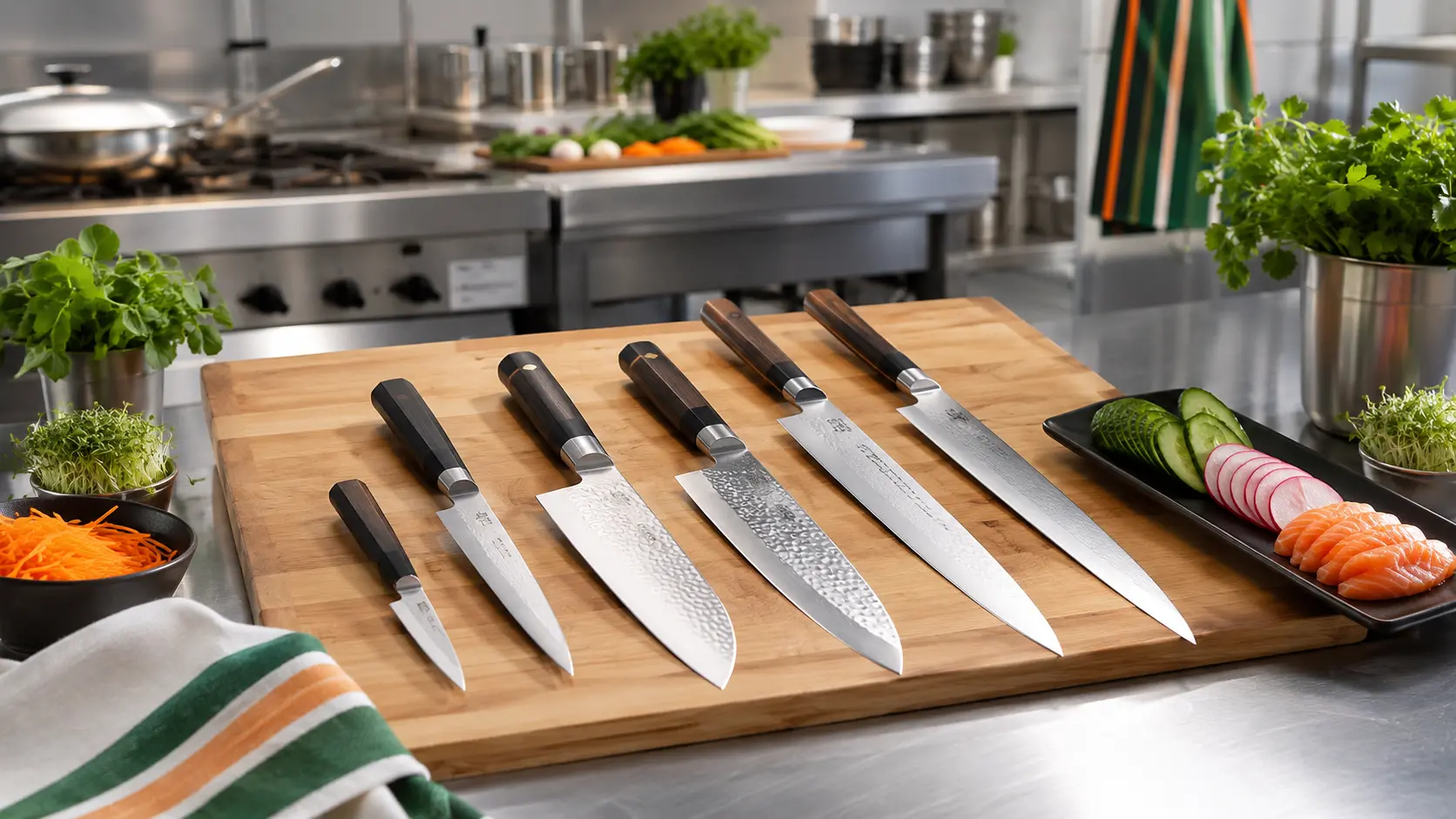
Choosing Japanese knives can feel a little overwhelming at first. There are gyuto knives, santoku knives, nakiri knives, petty knives and several specialist styles that all look beautifully made but seem to do slightly different jobs.

The good news is that most kitchens do not need a huge collection of Japanese knives. Whether you are preparing food in a restaurant, café, hotel, catering business or hospitality setting, the best starting point is usually a small, practical set that suits the way your kitchen works.

This guide explains which Japanese knives are genuinely useful, what each one is for and how to build a sensible knife selection without buying more than you need.

Key Takeaways

  • Most kitchens only need 2 or 3 Japanese knives to cover everyday preparation.
  • A gyuto or santoku is usually the best first Japanese knife.
  • A petty knife is useful for small, precise jobs.
  • A nakiri is ideal if your kitchen prepares lots of vegetables.
  • Specialist Japanese knives are helpful for certain tasks but are not essential for every kitchen.
  • Japanese knives need proper care, including hand washing, drying and safe storage.
  • A good chopping board and sharpening routine are just as important as the knives themselves.

Why Choose Japanese Knives?

Japanese knives, inlcuding Global chef knives are popular because they are sharp, precise and enjoyable to use. They are often thinner and lighter than many Western style kitchen knives, which makes them excellent for clean slicing, detailed prep and controlled cutting.

For chefs and catering teams, that sharpness can make everyday prep quicker and neater. Tomatoes slice without crushing. Herbs cut cleanly instead of bruising. Vegetables feel easier to control. Meat and fish can be trimmed with more accuracy.

They also have a certain appeal that is hard to ignore. A well made Japanese knife feels like a proper piece of kitchen craft, not just another utensil in the prep area.

What Makes Japanese Knives Different?

The main difference is usually the blade. Many Japanese knives are made with a harder steel than typical Western kitchen knives. This helps the blade hold a very sharp edge, although it can also mean the knife needs a little more care.

Japanese knives are often thinner behind the edge too. This means they pass through food with less resistance. You can feel this when slicing onions, carrots, fish or cooked meat. The cut feels cleaner and more controlled.

The trade off is that Japanese knives are not designed for rough treatment. They should not be used to chop through bones, frozen food or very hard items unless the knife is specifically made for that purpose.

Japanese Knives vs Western Knives

Western chef’s knives are often heavier, thicker and more forgiving. They are great general workhorses and can cope with a little more force. Japanese knives tend to favour precision, sharpness and clean slicing.

Neither style is automatically better. A busy kitchen may use both. A Western style chef’s knife may be better for tougher prep, while Japanese knives are excellent for accurate slicing, vegetable prep and fine finishing work.

The best choice depends on the way your kitchen operates. If your team prefers heavier knives and a rocking motion, some Japanese knives may take a little adjustment. If your chefs prefer lighter knives and a more controlled chopping or slicing action, Japanese knives can feel very natural.

Are Japanese Knives Suitable for Busy Commercial Kitchens?

Japanese knives can work very well in commercial kitchens, but they need to be chosen carefully. In a professional setting, knives are used for long periods, often by different members of staff. That means comfort, durability, safety and ease of cleaning all matter.

For a chef who looks after their own kit, Japanese knives can be a brilliant choice. For shared kitchen use, it may be better to choose more robust stainless steel options that can handle regular cleaning and day to day service pressure.

In catering, hospitality and food service environments, the question is not only “which knife is sharpest?” It is also “which knife is practical for our team?”

The First Japanese Knife Most Kitchens Should Buy

If you are buying your first Japanese knife, start with an all rounder. This should be the knife that gets used most often. It needs to handle vegetables, meat, fish, herbs and general preparation.

For most kitchens, that means choosing either a gyuto or a santoku.

Gyuto Knife

A gyuto is the Japanese version of a chef’s knife. It is one of the most versatile Japanese knives and is often the best choice for kitchens that want one main knife to do almost everything.

A gyuto can be used for:

  • Slicing meat
  • Cutting fish
  • Chopping vegetables
  • Preparing herbs
  • General kitchen prep

The blade is usually longer and slightly slimmer than a santoku. This makes it useful for longer slicing motions, especially when working with larger ingredients. If your team is used to Western chef’s knives, a gyuto will probably feel the most familiar.

For many kitchens, a gyuto between 180mm and 210mm is a sensible size. A 210mm gyuto gives you more cutting length, while a 180mm gyuto may feel easier in a smaller prep space.

Santoku Knife

A santoku knife is another excellent first Japanese knife. The name is often linked to 3 uses: slicing, dicing and chopping. In practical terms, it is a compact all round kitchen knife that works well for everyday food preparation.

A santoku is especially good for:

  • Vegetables
  • Boneless meat
  • Fish
  • Fruit
  • Everyday chopping tasks

The blade is usually shorter and taller than a gyuto. This can make it feel stable and easy to control. Many catering and hospitality kitchens like santoku knives because they are practical, versatile and comfortable for repetitive prep tasks.

A santoku is also useful in cafés, smaller commercial kitchens and prep areas where space is limited.

Gyuto vs Santoku: Which Is Better?

A gyuto is usually better if you want a slightly longer knife for slicing and general chef’s knife work. A santoku is usually better if you want a shorter, easy handling knife for everyday chopping.

Choose a gyuto if your kitchen regularly prepares larger ingredients, prefers longer slicing strokes or wants something closer to a Western chef’s knife.

Choose a santoku if you want a compact, balanced knife that feels comfortable for vegetables, smaller cuts of meat and daily prep.

You do not need both straight away. For your first Japanese knife, pick the one that best suits your workspace, menu and team.

The Essential Japanese Knives for Everyday Prep

Once you have a main knife, you can build a small set around it. For most kitchens, the most useful next step is a petty knife. After that, a nakiri may be worth considering if you prepare vegetables often.

A simple set of Japanese knives might look like this:

  • Gyuto or santoku for general prep
  • Petty knife for small tasks
  • Nakiri for vegetables

That is enough for a huge amount of kitchen work.

Petty Knife

A petty knife is a small utility knife. It is one of the most useful Japanese knives to own because it handles all the little jobs that feel awkward with a larger blade.

Use a petty knife for:

  • Peeling fruit
  • Trimming vegetables
  • Slicing small ingredients
  • Preparing garnish
  • Removing seeds
  • Small, quick cutting jobs

It is not the knife you use for everything, but it will be picked up constantly. In a professional kitchen, it can be useful for detailed work, finishing tasks and quick prep during service.

A petty knife is also a good choice for team members who find larger Japanese knives harder to control.

Nakiri Knife

A nakiri is a Japanese vegetable knife. It usually has a straight edge and a squared off tip, which makes it excellent for clean up and down chopping.

The nakiri is particularly useful for:

  • Onions
  • Cabbage
  • Carrots
  • Cucumbers
  • Peppers
  • Leafy greens
  • Batch vegetable prep

If your kitchen prepares salads, stir fries, soups, garnishes or large amounts of fresh produce, a nakiri can be a very useful addition.

It is not designed for bones, carving or heavy meat work. Its strength is clean, efficient vegetable preparation.

Bread Knife or Serrated Knife

A bread knife may not be the first thing people think of when discussing Japanese knives, but a practical kitchen still needs one. Sharp, smooth edged knives are not ideal for crusty bread, soft rolls or certain delicate items with tough skins.

A serrated knife is useful for:

  • Bread
  • Baps and rolls
  • Cakes
  • Pastries
  • Tomatoes
  • Foods with a firm outside and soft inside

If you are building a complete kitchen knife set, do not ignore the basics. A gyuto, petty knife and bread knife may be more useful than buying a specialist blade that only gets used occasionally.

Specialist Japanese Knives and When You Might Need Them

Some Japanese knives are designed for very specific jobs. They can be excellent in the right setting, but they are not essential for every kitchen.

Before buying a specialist knife, think about how often it will actually be used. A knife that looks impressive but sits in storage is not a good investment.

Deba Knife

A deba is a heavier Japanese knife traditionally used for fish preparation. It can be used for breaking down whole fish, removing heads and working around bones.

This is not usually a beginner knife. It is useful if your kitchen regularly prepares whole fish, especially in a seafood restaurant, sushi setting or fish focused menu.

For general catering and hospitality kitchens, a deba is not essential unless fish preparation is a regular part of the menu.

Yanagiba Knife

A yanagiba is a long slicing knife used for sashimi, sushi and very clean fish slicing. It is designed to make long, smooth cuts without sawing back and forth.

This knife is specialist, elegant and very good at its job. It is also unnecessary for most everyday catering kitchens.

A yanagiba makes sense if you prepare sushi, sashimi or delicate fish dishes often. If your kitchen mainly handles general prep, a gyuto will be far more useful.

Usuba Knife

An usuba is a traditional Japanese vegetable knife. It is often used by skilled chefs for precise vegetable work, including decorative cuts and fine preparation.

It can look similar to a nakiri, but it is more specialist and usually less forgiving. For most kitchens, a nakiri is the more practical vegetable knife.

Choose an usuba only if there is a real need for traditional Japanese vegetable preparation techniques.

Kiritsuke Knife

A kiritsuke is often seen as a striking, advanced Japanese knife. It has a distinctive angled tip and can be used for slicing and vegetable work, depending on the design.

It is not usually the best first choice. The shape can take more skill to use well, and it may not feel as easy as a gyuto or santoku for general prep.

A kiritsuke is better suited to confident chefs who already understand what they want from Japanese knives.

How Many Japanese Knives Does a Commercial Kitchen Really Need?

It is easy to get carried away when looking at Japanese knives. Many are beautifully made, and each shape has a purpose. That does not mean every kitchen needs all of them.

A good knife set should match your menu, your preparation tasks and the way your team works.

For Restaurants and Professional Chefs

Professional chefs may need a more tailored set. This depends on the section they work on, the style of food being prepared and whether the knives are personal kit or shared kitchen tools.

A chef might use:

  • Gyuto for general prep
  • Petty knife for smaller tasks
  • Nakiri for vegetables
  • Yanagiba for fish slicing
  • Deba for fish preparation
  • Serrated knife for bread and pastry

Even then, it is better to buy carefully than to buy everything at once. A small number of excellent Japanese knives that are used every day will always be more valuable than a large set that rarely leaves the knife roll.

For Cafés, Caterers and Hospitality Kitchens

Commercial kitchens need practical decisions. The best Japanese knives for these settings are usually reliable, hygienic, comfortable and easy to maintain.

A café may need a santoku, petty knife and bread knife for sandwiches, fruit, cakes and light prep. A restaurant may need gyuto knives for chef stations and nakiri knives for vegetable prep. A catering business may need a mix of robust stainless steel knives that travel well and clean easily.

In these environments, storage and safety are also important. Knife blocks, rolls, guards and suitable chopping boards should be part of the buying decision.

For Shared Kitchen Use

Shared knives need to be practical above all else. If several team members will be using the same knives, it is usually best to choose styles that are durable, easy to clean and not too delicate.

Stainless steel Japanese knives are often a sensible choice for shared use. They are easier to maintain than carbon steel and better suited to busy catering environments where equipment may be washed and reused many times throughout the day.

It is also worth keeping the selection simple. A clear set of general prep, small prep and bread knives is easier to manage than a large collection of specialist blades that staff may not use correctly.

What to Consider Before Buying Japanese Knives

Before buying Japanese knives, think beyond the blade shape. The steel, handle, length and maintenance requirements all affect how useful the knife will be.

The right knife should feel comfortable, suit the work being done and fit into your kitchen’s cleaning and storage routine.

Blade Steel

Japanese knives are available in different steels. The main choice is usually between stainless steel and carbon steel.

Stainless steel is easier to maintain. It resists rust better and is usually more practical for busy kitchens, shared use and commercial settings.

Carbon steel can take a very sharp edge and is loved by many chefs. It needs more care because it can rust or discolour if left wet or if acidic food is left on the blade.

Layered or Damascus style steels are also common. These can look beautiful, but the appearance should not be the only reason to buy. The knife still needs to suit your tasks, your team and your maintenance routine.

Handle Type

Japanese knives may have a traditional Japanese handle or a Western style handle.

Traditional Japanese handles are often lighter and may be round, oval or octagonal. They can make the knife feel more blade forward and precise.

Western style handles may feel more familiar if your team already uses European style kitchen knives. They can offer a secure grip and may suit people who prefer a slightly heavier feel.

There is no universal best option. Comfort matters most.

Blade Length

Blade length affects control, speed and workspace.

Common choices include:

  • 120mm to 150mm for petty knives
  • 165mm to 180mm for santoku and nakiri knives
  • 180mm to 240mm for gyuto knives

Shorter blades are easier to control and store. Longer blades are better for larger ingredients and longer slicing strokes.

For many commercial kitchens, a 180mm santoku or a 210mm gyuto is a sensible starting point.

Maintenance and Sharpening

Japanese knives are often bought for sharpness, but that sharpness needs looking after. A blunt premium knife is still a blunt knife.

Proper care includes:

  • Washing by hand
  • Drying straight away
  • Using a suitable chopping board
  • Avoiding glass or stone boards
  • Storing the blade safely
  • Sharpening when needed

Many Japanese knives are best sharpened on whetstones, although this takes practice. Some kitchens prefer to have knives professionally sharpened with a knife sharpener, especially where consistent performance is important.

Caring for Japanese Knives Properly

Good care will help Japanese knives last longer and perform better. Poor care can damage even a very expensive knife.

Always wash Japanese knives by hand. Do not leave them soaking in a sink, especially in a busy kitchen where someone may not see the blade. Clean the knife carefully, dry it straight away and store it safely.

Avoid putting Japanese knives in the dishwasher. The heat, detergent and movement can damage the edge, handle and finish. Dishwashers are convenient, but they are not kind to quality knives.

Use a suitable chopping board. Wooden and good quality plastic chopping boards are usually kinder to knife edges than glass, marble or stone. Very hard boards can dull the edge quickly.

Safe storage matters too. A knife block, magnetic rack, knife roll or blade guard can help protect the edge and reduce accidents.

For commercial kitchens, it is also worth thinking about the full preparation area. Chopping boards, cleaning products, catering equipment, chefs’ clothing and safe storage all support good knife use. Hygiene.ie can be a useful place to source practical catering and kitchen supplies alongside other hospitality essentials.

FAQ: What Japanese Knives Do I Need?

What is the best Japanese knife for a commercial kitchen?

The best Japanese knife for a commercial kitchen is usually a gyuto or santoku. A gyuto is a versatile chef’s knife style that works well for slicing, chopping and general prep. A santoku is more compact and is excellent for everyday chopping tasks.

For many catering and hospitality settings, stainless steel is the most practical choice because it is easier to maintain than carbon steel.

Do I need both a gyuto and a santoku?

You do not need both to start with. A gyuto and santoku overlap quite a lot because both are general purpose Japanese knives.

A gyuto is usually better for longer slicing strokes and larger ingredients. A santoku is usually better if you prefer a shorter, compact knife. Most kitchens should buy one first, then add the other later only if there is a genuine need.

Are Japanese knives good for professional kitchens?

Japanese knives can be excellent in professional kitchens, especially when used by chefs who look after their own equipment. They are sharp, precise and comfortable for many preparation tasks.

For shared kitchen use, stainless steel Japanese knives may be more practical than high maintenance carbon steel knives. Commercial kitchens should also consider cleaning routines, storage, staff training and durability.

Can Japanese knives go in the dishwasher?

Japanese knives should not go in the dishwasher. Dishwashers can damage the blade edge, handle and finish. The knife may also knock against other items during the wash cycle.

It is much better to wash Japanese knives by hand, dry them immediately and store them safely.

What is the difference between a nakiri and a santoku?

A nakiri is mainly a vegetable knife. It has a straighter blade that works well for up and down chopping. It is excellent for onions, cabbage, leafy greens and other vegetables.

A santoku is more of an all rounder. It can handle vegetables, boneless meat, fish and general preparation. If you only want one knife style, choose a santoku. If you already have a main knife and prepare lots of vegetables, a nakiri is a useful addition.

How often should Japanese knives be sharpened?

This depends on how often they are used. A small café may not need sharpening as often as a busy restaurant kitchen. A chef using the same knife every day may need to sharpen it much more regularly.

The better guide is performance. If the knife starts slipping on tomato skin, crushing herbs or dragging through food, it probably needs sharpening.

What Japanese knives does a catering kitchen need?

A catering kitchen will usually benefit from a gyuto or santoku for general prep, a petty knife for small tasks and a bread knife for rolls, bread and pastries. If the kitchen prepares a lot of vegetables, a nakiri is also worth considering.

For shared use, choose practical knives that are easy to clean, store and maintain.

Are expensive Japanese knives worth it?

Expensive Japanese knives can be worth it if they are used regularly, cared for properly and suited to the work being done. They may hold an edge well, feel better balanced and make preparation more enjoyable.

They are not always necessary though. A sensible, well maintained mid range knife is often a better choice than an expensive knife that is used incorrectly or left in storage.

The best Japanese knives are the ones that suit your kitchen, your menu and your maintenance habits.

3 products found
Sort by
Vogue Tsuki Series 7 Santoku Knife Black 17.5cm
Vogue Tsuki 3-Piece Knife Set Series 7
Rockingham Forge Ceramic Stone Combination (Coarse/ Medium) Sharpening Kit
Total 3 products
3 products found
Sort by
Vogue Tsuki Series 7 Santoku Knife Black 17.5cm
Vogue Tsuki 3-Piece Knife Set Series 7
Rockingham Forge Ceramic Stone Combination (Coarse/ Medium) Sharpening Kit
Total 3 products

What Japanese Knives Do I Need?

17 min

Choosing Japanese knives can feel a little overwhelming at first. There are gyuto knives, santoku knives, nakiri knives, petty knives and several specialist styles that all look beautifully made but seem to do slightly different jobs.

The good news is that most kitchens do not need a huge collection of Japanese knives. Whether you are preparing food in a restaurant, café, hotel, catering business or hospitality setting, the best starting point is usually a small, practical set that suits the way your kitchen works.

This guide explains which Japanese knives are genuinely useful, what each one is for and how to build a sensible knife selection without buying more than you need.

Key Takeaways

  • Most kitchens only need 2 or 3 Japanese knives to cover everyday preparation.
  • A gyuto or santoku is usually the best first Japanese knife.
  • A petty knife is useful for small, precise jobs.
  • A nakiri is ideal if your kitchen prepares lots of vegetables.
  • Specialist Japanese knives are helpful for certain tasks but are not essential for every kitchen.
  • Japanese knives need proper care, including hand washing, drying and safe storage.
  • A good chopping board and sharpening routine are just as important as the knives themselves.

Why Choose Japanese Knives?

Japanese knives, inlcuding Global chef knives are popular because they are sharp, precise and enjoyable to use. They are often thinner and lighter than many Western style kitchen knives, which makes them excellent for clean slicing, detailed prep and controlled cutting.

For chefs and catering teams, that sharpness can make everyday prep quicker and neater. Tomatoes slice without crushing. Herbs cut cleanly instead of bruising. Vegetables feel easier to control. Meat and fish can be trimmed with more accuracy.

They also have a certain appeal that is hard to ignore. A well made Japanese knife feels like a proper piece of kitchen craft, not just another utensil in the prep area.

What Makes Japanese Knives Different?

The main difference is usually the blade. Many Japanese knives are made with a harder steel than typical Western kitchen knives. This helps the blade hold a very sharp edge, although it can also mean the knife needs a little more care.

Japanese knives are often thinner behind the edge too. This means they pass through food with less resistance. You can feel this when slicing onions, carrots, fish or cooked meat. The cut feels cleaner and more controlled.

The trade off is that Japanese knives are not designed for rough treatment. They should not be used to chop through bones, frozen food or very hard items unless the knife is specifically made for that purpose.

Japanese Knives vs Western Knives

Western chef’s knives are often heavier, thicker and more forgiving. They are great general workhorses and can cope with a little more force. Japanese knives tend to favour precision, sharpness and clean slicing.

Neither style is automatically better. A busy kitchen may use both. A Western style chef’s knife may be better for tougher prep, while Japanese knives are excellent for accurate slicing, vegetable prep and fine finishing work.

The best choice depends on the way your kitchen operates. If your team prefers heavier knives and a rocking motion, some Japanese knives may take a little adjustment. If your chefs prefer lighter knives and a more controlled chopping or slicing action, Japanese knives can feel very natural.

Are Japanese Knives Suitable for Busy Commercial Kitchens?

Japanese knives can work very well in commercial kitchens, but they need to be chosen carefully. In a professional setting, knives are used for long periods, often by different members of staff. That means comfort, durability, safety and ease of cleaning all matter.

For a chef who looks after their own kit, Japanese knives can be a brilliant choice. For shared kitchen use, it may be better to choose more robust stainless steel options that can handle regular cleaning and day to day service pressure.

In catering, hospitality and food service environments, the question is not only “which knife is sharpest?” It is also “which knife is practical for our team?”

The First Japanese Knife Most Kitchens Should Buy

If you are buying your first Japanese knife, start with an all rounder. This should be the knife that gets used most often. It needs to handle vegetables, meat, fish, herbs and general preparation.

For most kitchens, that means choosing either a gyuto or a santoku.

Gyuto Knife

A gyuto is the Japanese version of a chef’s knife. It is one of the most versatile Japanese knives and is often the best choice for kitchens that want one main knife to do almost everything.

A gyuto can be used for:

  • Slicing meat
  • Cutting fish
  • Chopping vegetables
  • Preparing herbs
  • General kitchen prep

The blade is usually longer and slightly slimmer than a santoku. This makes it useful for longer slicing motions, especially when working with larger ingredients. If your team is used to Western chef’s knives, a gyuto will probably feel the most familiar.

For many kitchens, a gyuto between 180mm and 210mm is a sensible size. A 210mm gyuto gives you more cutting length, while a 180mm gyuto may feel easier in a smaller prep space.

Santoku Knife

A santoku knife is another excellent first Japanese knife. The name is often linked to 3 uses: slicing, dicing and chopping. In practical terms, it is a compact all round kitchen knife that works well for everyday food preparation.

A santoku is especially good for:

  • Vegetables
  • Boneless meat
  • Fish
  • Fruit
  • Everyday chopping tasks

The blade is usually shorter and taller than a gyuto. This can make it feel stable and easy to control. Many catering and hospitality kitchens like santoku knives because they are practical, versatile and comfortable for repetitive prep tasks.

A santoku is also useful in cafés, smaller commercial kitchens and prep areas where space is limited.

Gyuto vs Santoku: Which Is Better?

A gyuto is usually better if you want a slightly longer knife for slicing and general chef’s knife work. A santoku is usually better if you want a shorter, easy handling knife for everyday chopping.

Choose a gyuto if your kitchen regularly prepares larger ingredients, prefers longer slicing strokes or wants something closer to a Western chef’s knife.

Choose a santoku if you want a compact, balanced knife that feels comfortable for vegetables, smaller cuts of meat and daily prep.

You do not need both straight away. For your first Japanese knife, pick the one that best suits your workspace, menu and team.

The Essential Japanese Knives for Everyday Prep

Once you have a main knife, you can build a small set around it. For most kitchens, the most useful next step is a petty knife. After that, a nakiri may be worth considering if you prepare vegetables often.

A simple set of Japanese knives might look like this:

  • Gyuto or santoku for general prep
  • Petty knife for small tasks
  • Nakiri for vegetables

That is enough for a huge amount of kitchen work.

Petty Knife

A petty knife is a small utility knife. It is one of the most useful Japanese knives to own because it handles all the little jobs that feel awkward with a larger blade.

Use a petty knife for:

  • Peeling fruit
  • Trimming vegetables
  • Slicing small ingredients
  • Preparing garnish
  • Removing seeds
  • Small, quick cutting jobs

It is not the knife you use for everything, but it will be picked up constantly. In a professional kitchen, it can be useful for detailed work, finishing tasks and quick prep during service.

A petty knife is also a good choice for team members who find larger Japanese knives harder to control.

Nakiri Knife

A nakiri is a Japanese vegetable knife. It usually has a straight edge and a squared off tip, which makes it excellent for clean up and down chopping.

The nakiri is particularly useful for:

  • Onions
  • Cabbage
  • Carrots
  • Cucumbers
  • Peppers
  • Leafy greens
  • Batch vegetable prep

If your kitchen prepares salads, stir fries, soups, garnishes or large amounts of fresh produce, a nakiri can be a very useful addition.

It is not designed for bones, carving or heavy meat work. Its strength is clean, efficient vegetable preparation.

Bread Knife or Serrated Knife

A bread knife may not be the first thing people think of when discussing Japanese knives, but a practical kitchen still needs one. Sharp, smooth edged knives are not ideal for crusty bread, soft rolls or certain delicate items with tough skins.

A serrated knife is useful for:

  • Bread
  • Baps and rolls
  • Cakes
  • Pastries
  • Tomatoes
  • Foods with a firm outside and soft inside

If you are building a complete kitchen knife set, do not ignore the basics. A gyuto, petty knife and bread knife may be more useful than buying a specialist blade that only gets used occasionally.

Specialist Japanese Knives and When You Might Need Them

Some Japanese knives are designed for very specific jobs. They can be excellent in the right setting, but they are not essential for every kitchen.

Before buying a specialist knife, think about how often it will actually be used. A knife that looks impressive but sits in storage is not a good investment.

Deba Knife

A deba is a heavier Japanese knife traditionally used for fish preparation. It can be used for breaking down whole fish, removing heads and working around bones.

This is not usually a beginner knife. It is useful if your kitchen regularly prepares whole fish, especially in a seafood restaurant, sushi setting or fish focused menu.

For general catering and hospitality kitchens, a deba is not essential unless fish preparation is a regular part of the menu.

Yanagiba Knife

A yanagiba is a long slicing knife used for sashimi, sushi and very clean fish slicing. It is designed to make long, smooth cuts without sawing back and forth.

This knife is specialist, elegant and very good at its job. It is also unnecessary for most everyday catering kitchens.

A yanagiba makes sense if you prepare sushi, sashimi or delicate fish dishes often. If your kitchen mainly handles general prep, a gyuto will be far more useful.

Usuba Knife

An usuba is a traditional Japanese vegetable knife. It is often used by skilled chefs for precise vegetable work, including decorative cuts and fine preparation.

It can look similar to a nakiri, but it is more specialist and usually less forgiving. For most kitchens, a nakiri is the more practical vegetable knife.

Choose an usuba only if there is a real need for traditional Japanese vegetable preparation techniques.

Kiritsuke Knife

A kiritsuke is often seen as a striking, advanced Japanese knife. It has a distinctive angled tip and can be used for slicing and vegetable work, depending on the design.

It is not usually the best first choice. The shape can take more skill to use well, and it may not feel as easy as a gyuto or santoku for general prep.

A kiritsuke is better suited to confident chefs who already understand what they want from Japanese knives.

How Many Japanese Knives Does a Commercial Kitchen Really Need?

It is easy to get carried away when looking at Japanese knives. Many are beautifully made, and each shape has a purpose. That does not mean every kitchen needs all of them.

A good knife set should match your menu, your preparation tasks and the way your team works.

For Restaurants and Professional Chefs

Professional chefs may need a more tailored set. This depends on the section they work on, the style of food being prepared and whether the knives are personal kit or shared kitchen tools.

A chef might use:

  • Gyuto for general prep
  • Petty knife for smaller tasks
  • Nakiri for vegetables
  • Yanagiba for fish slicing
  • Deba for fish preparation
  • Serrated knife for bread and pastry

Even then, it is better to buy carefully than to buy everything at once. A small number of excellent Japanese knives that are used every day will always be more valuable than a large set that rarely leaves the knife roll.

For Cafés, Caterers and Hospitality Kitchens

Commercial kitchens need practical decisions. The best Japanese knives for these settings are usually reliable, hygienic, comfortable and easy to maintain.

A café may need a santoku, petty knife and bread knife for sandwiches, fruit, cakes and light prep. A restaurant may need gyuto knives for chef stations and nakiri knives for vegetable prep. A catering business may need a mix of robust stainless steel knives that travel well and clean easily.

In these environments, storage and safety are also important. Knife blocks, rolls, guards and suitable chopping boards should be part of the buying decision.

For Shared Kitchen Use

Shared knives need to be practical above all else. If several team members will be using the same knives, it is usually best to choose styles that are durable, easy to clean and not too delicate.

Stainless steel Japanese knives are often a sensible choice for shared use. They are easier to maintain than carbon steel and better suited to busy catering environments where equipment may be washed and reused many times throughout the day.

It is also worth keeping the selection simple. A clear set of general prep, small prep and bread knives is easier to manage than a large collection of specialist blades that staff may not use correctly.

What to Consider Before Buying Japanese Knives

Before buying Japanese knives, think beyond the blade shape. The steel, handle, length and maintenance requirements all affect how useful the knife will be.

The right knife should feel comfortable, suit the work being done and fit into your kitchen’s cleaning and storage routine.

Blade Steel

Japanese knives are available in different steels. The main choice is usually between stainless steel and carbon steel.

Stainless steel is easier to maintain. It resists rust better and is usually more practical for busy kitchens, shared use and commercial settings.

Carbon steel can take a very sharp edge and is loved by many chefs. It needs more care because it can rust or discolour if left wet or if acidic food is left on the blade.

Layered or Damascus style steels are also common. These can look beautiful, but the appearance should not be the only reason to buy. The knife still needs to suit your tasks, your team and your maintenance routine.

Handle Type

Japanese knives may have a traditional Japanese handle or a Western style handle.

Traditional Japanese handles are often lighter and may be round, oval or octagonal. They can make the knife feel more blade forward and precise.

Western style handles may feel more familiar if your team already uses European style kitchen knives. They can offer a secure grip and may suit people who prefer a slightly heavier feel.

There is no universal best option. Comfort matters most.

Blade Length

Blade length affects control, speed and workspace.

Common choices include:

  • 120mm to 150mm for petty knives
  • 165mm to 180mm for santoku and nakiri knives
  • 180mm to 240mm for gyuto knives

Shorter blades are easier to control and store. Longer blades are better for larger ingredients and longer slicing strokes.

For many commercial kitchens, a 180mm santoku or a 210mm gyuto is a sensible starting point.

Maintenance and Sharpening

Japanese knives are often bought for sharpness, but that sharpness needs looking after. A blunt premium knife is still a blunt knife.

Proper care includes:

  • Washing by hand
  • Drying straight away
  • Using a suitable chopping board
  • Avoiding glass or stone boards
  • Storing the blade safely
  • Sharpening when needed

Many Japanese knives are best sharpened on whetstones, although this takes practice. Some kitchens prefer to have knives professionally sharpened with a knife sharpener, especially where consistent performance is important.

Caring for Japanese Knives Properly

Good care will help Japanese knives last longer and perform better. Poor care can damage even a very expensive knife.

Always wash Japanese knives by hand. Do not leave them soaking in a sink, especially in a busy kitchen where someone may not see the blade. Clean the knife carefully, dry it straight away and store it safely.

Avoid putting Japanese knives in the dishwasher. The heat, detergent and movement can damage the edge, handle and finish. Dishwashers are convenient, but they are not kind to quality knives.

Use a suitable chopping board. Wooden and good quality plastic chopping boards are usually kinder to knife edges than glass, marble or stone. Very hard boards can dull the edge quickly.

Safe storage matters too. A knife block, magnetic rack, knife roll or blade guard can help protect the edge and reduce accidents.

For commercial kitchens, it is also worth thinking about the full preparation area. Chopping boards, cleaning products, catering equipment, chefs’ clothing and safe storage all support good knife use. Hygiene.ie can be a useful place to source practical catering and kitchen supplies alongside other hospitality essentials.

FAQ: What Japanese Knives Do I Need?

What is the best Japanese knife for a commercial kitchen?

The best Japanese knife for a commercial kitchen is usually a gyuto or santoku. A gyuto is a versatile chef’s knife style that works well for slicing, chopping and general prep. A santoku is more compact and is excellent for everyday chopping tasks.

For many catering and hospitality settings, stainless steel is the most practical choice because it is easier to maintain than carbon steel.

Do I need both a gyuto and a santoku?

You do not need both to start with. A gyuto and santoku overlap quite a lot because both are general purpose Japanese knives.

A gyuto is usually better for longer slicing strokes and larger ingredients. A santoku is usually better if you prefer a shorter, compact knife. Most kitchens should buy one first, then add the other later only if there is a genuine need.

Are Japanese knives good for professional kitchens?

Japanese knives can be excellent in professional kitchens, especially when used by chefs who look after their own equipment. They are sharp, precise and comfortable for many preparation tasks.

For shared kitchen use, stainless steel Japanese knives may be more practical than high maintenance carbon steel knives. Commercial kitchens should also consider cleaning routines, storage, staff training and durability.

Can Japanese knives go in the dishwasher?

Japanese knives should not go in the dishwasher. Dishwashers can damage the blade edge, handle and finish. The knife may also knock against other items during the wash cycle.

It is much better to wash Japanese knives by hand, dry them immediately and store them safely.

What is the difference between a nakiri and a santoku?

A nakiri is mainly a vegetable knife. It has a straighter blade that works well for up and down chopping. It is excellent for onions, cabbage, leafy greens and other vegetables.

A santoku is more of an all rounder. It can handle vegetables, boneless meat, fish and general preparation. If you only want one knife style, choose a santoku. If you already have a main knife and prepare lots of vegetables, a nakiri is a useful addition.

How often should Japanese knives be sharpened?

This depends on how often they are used. A small café may not need sharpening as often as a busy restaurant kitchen. A chef using the same knife every day may need to sharpen it much more regularly.

The better guide is performance. If the knife starts slipping on tomato skin, crushing herbs or dragging through food, it probably needs sharpening.

What Japanese knives does a catering kitchen need?

A catering kitchen will usually benefit from a gyuto or santoku for general prep, a petty knife for small tasks and a bread knife for rolls, bread and pastries. If the kitchen prepares a lot of vegetables, a nakiri is also worth considering.

For shared use, choose practical knives that are easy to clean, store and maintain.

Are expensive Japanese knives worth it?

Expensive Japanese knives can be worth it if they are used regularly, cared for properly and suited to the work being done. They may hold an edge well, feel better balanced and make preparation more enjoyable.

They are not always necessary though. A sensible, well maintained mid range knife is often a better choice than an expensive knife that is used incorrectly or left in storage.

The best Japanese knives are the ones that suit your kitchen, your menu and your maintenance habits.

SEARCH ×

Search