


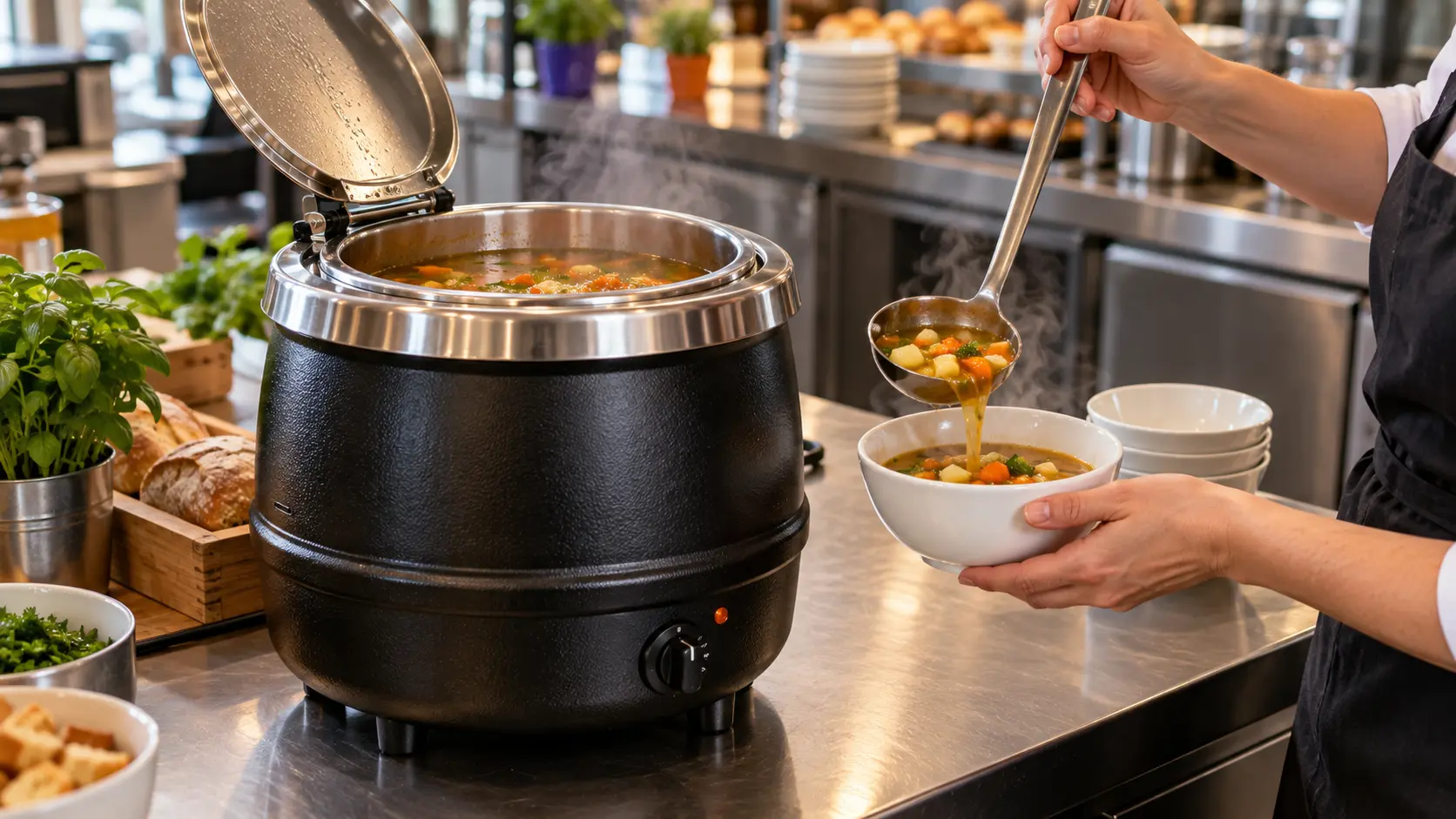
A soup kettle keeps prepared soup hot and ready to serve. It is a useful addition to a café counter, buffet or staff canteen, but choosing one involves more than picking a capacity. You need to know how it heats, how many portions you will serve between refills and how it fits into your food safety routine.
Key takeaways
- A soup kettle is primarily for holding soup that has already been cooked and heated.
- Wet heat models use a water bath; dry heat models warm the inner pot without one.
- Allow roughly 250–300ml per serving when estimating capacity, then account for the maximum fill level.
- Choose a size for your busiest period between refills, rather than your total sales for the day.
- Check the temperature of the food itself during service, rather than relying only on the kettle’s control setting.
What does a soup kettle actually do?
A commercial soup kettle is a countertop appliance designed to hold hot food at serving temperature. The removable inner pot holds the soup, while the heated outer unit helps maintain its temperature during service. A lid reduces heat loss and helps protect the contents between servings.
That makes a kettle convenient when customers are served over several hours. Staff can ladle portions as needed without keeping a pan on the hob. Many models can also hold suitable foods such as stews, sauces or chilli, subject to the manufacturer’s instructions and your food safety procedures.
The important distinction is between cooking and hot holding. Most soup kettles are intended to maintain the temperature of food that has already been heated. If you are comparing models, the soup kettles and hotpots category includes several sizes and heating styles.
How does a soup kettle work?
The usual process is straightforward: cook and heat the soup using suitable kitchen equipment, prepare the kettle according to its instructions, transfer the hot soup into the inner pot and use the kettle to maintain its temperature. How heat reaches that pot depends on the model.
Wet heat soup kettles
A wet heat kettle has a water reservoir between the outer body and the food container. The appliance heats the water, which transfers heat to the removable inner pot. This provides gentle, indirect heating for soup and sauces.
Add water to the outer reservoir at the level specified in the instructions. The soup goes in the separate inner pot. The Dualit 6 litre soup kettle is an example of a wet heat model.
Dry heat soup kettles
A dry heat model warms the inner pot without a water bath. There is no reservoir to fill or monitor, which may appeal to a busy counter team.
The Rowlett Heat & Hold 10 litre kettle, for example, has dry heat, a removable inner pot and digital temperature controls. Check the instructions for your chosen model, as features differ.
Neither heating style removes the need to check the food temperature. Soup thickness, how full the pot is and how often the lid is opened can all affect conditions during service. Stir the contents as appropriate to help distribute heat evenly.
Can you cook or reheat soup in a soup kettle?
Usually, you should cook and heat the soup before transferring it to the kettle. A hot-holding appliance can take too long to bring cold food up to temperature. Preheat the kettle as its instructions require, then add the already hot soup.
For batch preparation, use suitable cooking equipment such as the appropriately sized boiling pots and stockpots. Some soup kettle models have an inner pot that can be used separately on a hob. That does not mean the electric kettle base is designed to cook soup from cold, and hob compatibility is not universal.
The same principle matters when topping up. Follow your food safety procedures for heating a fresh batch rather than pouring cold soup into a partly full kettle and expecting the holding unit to heat it quickly.
What size soup kettle do you need?
Start with the number of portions you expect to serve before you can refill the kettle. A 10 litre model is not automatically necessary for a business that sells 40 bowls across a whole day. A smaller kettle may work well if staff can replenish it safely between rushes.
Portion size matters too. A small cup may hold around 250ml of soup, while a generous bowl may take 300ml or more. Measure your actual serving with a soup ladle and your chosen bowl before deciding how much capacity you need.
A quick guide to portions
These figures divide the kettle’s nominal capacity by the stated portion size. They help you compare models, but they are not a promise of how many full servings you will get. Maximum fill marks, space for stirring and small losses during ladling can reduce the practical yield.
| Kettle capacity | At 250ml per serving | At 300ml per serving |
|---|---|---|
| 5.7 litres | About 22 portions | About 19 portions |
| 6 litres | About 24 portions | About 20 portions |
| 9 litres | About 36 portions | About 30 portions |
| 10 litres | About 40 portions | About 33 portions |
For example, 18 bowls at 300ml each require 5.4 litres of soup before allowing for the kettle’s fill limit. A nominal 6 litre model would be a tight fit, so a larger model or a planned refill may be more practical.
Small counter or busy buffet?
A 5.7 or 6 litre kettle can suit a smaller café, takeaway counter or venue with moderate demand and regular opportunities to refill. It may also work well when you offer more than one flavour and want a separate kettle for each.
A 9 or 10 litre kettle provides more capacity for a sustained lunch rush, buffet or canteen service. It also takes up more counter space and needs a sensible plan for preparing, moving and serving a larger quantity of hot food.
If you offer two soups at once, calculate demand for each flavour separately. A single 10 litre kettle cannot keep tomato and vegetable soup separate, even if their combined sales would fit within its capacity.
What else should you check before buying?
Capacity is the first filter, but the details of daily use often decide which kettle feels right on your counter.
Controls and temperature checks
Look at how the kettle is adjusted and whether staff can use its controls easily during service. A thermostat or digital setting helps manage the appliance, but its display or dial does not necessarily tell you the temperature throughout the food. Build probe checks into your normal hot-holding procedure.
Inner pot, lid and cleaning
A removable inner pot makes it easier to empty and wash the food-contact surface. Consider whether the lid gives staff easy access for ladling and whether it stays conveniently in place during a busy period. Check the cleaning instructions, as the electrical outer unit generally needs different care from the removable pot.
Counter space and service layout
Measure the available surface and leave enough room for staff to lift the lid and ladle soup without reaching across other equipment. Think about where bowls, toppings and serving utensils will sit. If you serve several hot dishes alongside soup, compare the kettle with bains marie and other servery and display machines.
Service also affects what you buy around the kettle. For eating in, choose bowls that suit your portion size, such as those in the Athena hotelware crockery range. For takeaway, consider suitable soup containers and lids. Our guide to choosing catering disposables covers the wider packaging decisions for takeaway and event service.
If soup forms part of a larger self-service buffet, a kettle is only one way to present hot food. Our chafing dish buying guide explains the options for serving other prepared dishes alongside it.
Keeping soup ready for safe service
Preheat the kettle according to its manual, then transfer soup that has already been thoroughly cooked and heated. Keep the lid closed when practical and check the food with a clean, suitable probe during service. The Food Safety Authority of Ireland’s temperature control guidance says hot-held food should be kept above 63°C. Follow your food safety procedures for monitoring, recording temperatures and dealing with food that falls below the required level.
A soup kettle keeps a prepared batch available through service. It does not replace the steps needed to cook, reheat, cool or store food safely. Once you know your portion size and peak demand, choosing between a compact kettle and a larger one becomes much easier.
Frequently asked questions
Do you put water in a soup kettle?
Only if the model uses wet heat. Add water to the outer reservoir at the level specified by the manufacturer; put the soup in the separate inner pot. A dry heat kettle does not require a water bath.
How many servings will a 10 litre soup kettle hold?
At a nominal capacity of 10 litres, the calculation is about 40 servings of 250ml or 33 servings of 300ml. Allow for the maximum fill level and the way you portion soup in practice.
Can you use a soup kettle for foods other than soup?
Many kettles can hold suitable hot foods such as sauces, stews or chilli. Check the model’s instructions, particularly for thicker foods that may need stirring, and apply the same hot-holding checks to the food.
Is a soup kettle the same as a soup maker?
No. A soup maker prepares soup, while a commercial soup kettle is principally used to keep prepared soup hot for serving. Check the instructions for your chosen appliance before using it for any cooking or reheating task.


